AI product studio · Seattle
Humans and AI,
working in tandem.
We design and build AI products that people use. Every product is grounded in real data, private by default, tested against the best AI models, and tried extensively by real people before it launches.
90%of each question's checklist met by PATHWAYS in a blind test. Claude met 67%, ChatGPT 59%, Gemini 57%.
3 weeksfrom first commit to a licensed product for a Gates Foundation–backed startup.
16,900industrial facilities across North America mapped from public records in MatterMatch.
5AI companies' models reasoning together in a single Discussion.
Try it here
Ask three AI models at once.
Models from Anthropic, OpenAI and Google answer on their own, without seeing each other. Then one of them reads all three and sums up where they agree and differ. A small taste of The Discussion.
GPT OpenAI
Gemini Google
Where they land
Answers go only to AI providers that keep no data, and nothing is saved here, but please leave out personal details. A few questions a day per visitor. For the full room, with five models, a real conversation and voices, visit theroom.click.
Selected work
Live products, not slide decks.
Each of these is running today. Most were built in weeks.
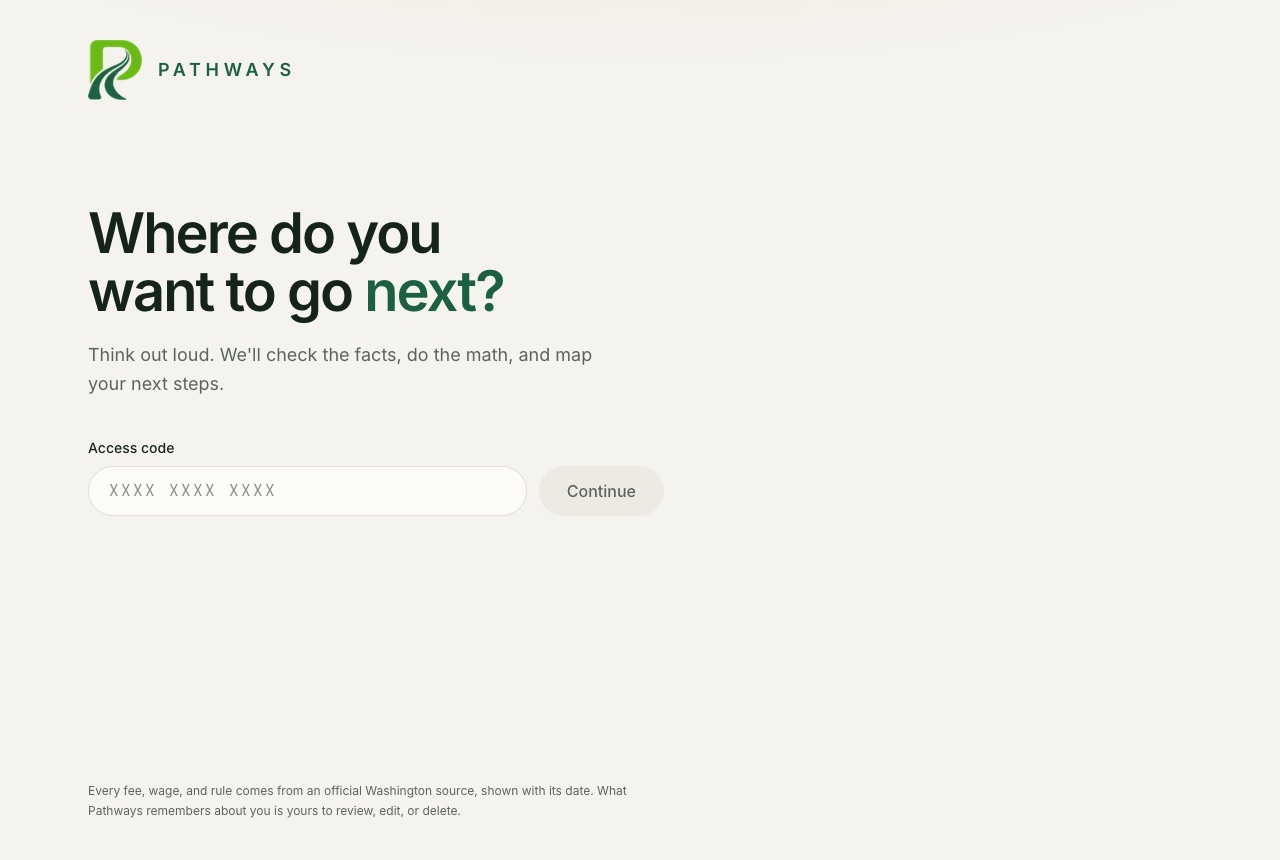
Education & careers · Licensed to CampusEvolve
PATHWAYS
A mobile-first guide that turns a person's goal into a route, next steps and wins, for high school seniors, parents going back to work, people coming home from incarceration and professionals trained abroad. Every wage, fee and deadline comes from an official Washington source, shown with its date.
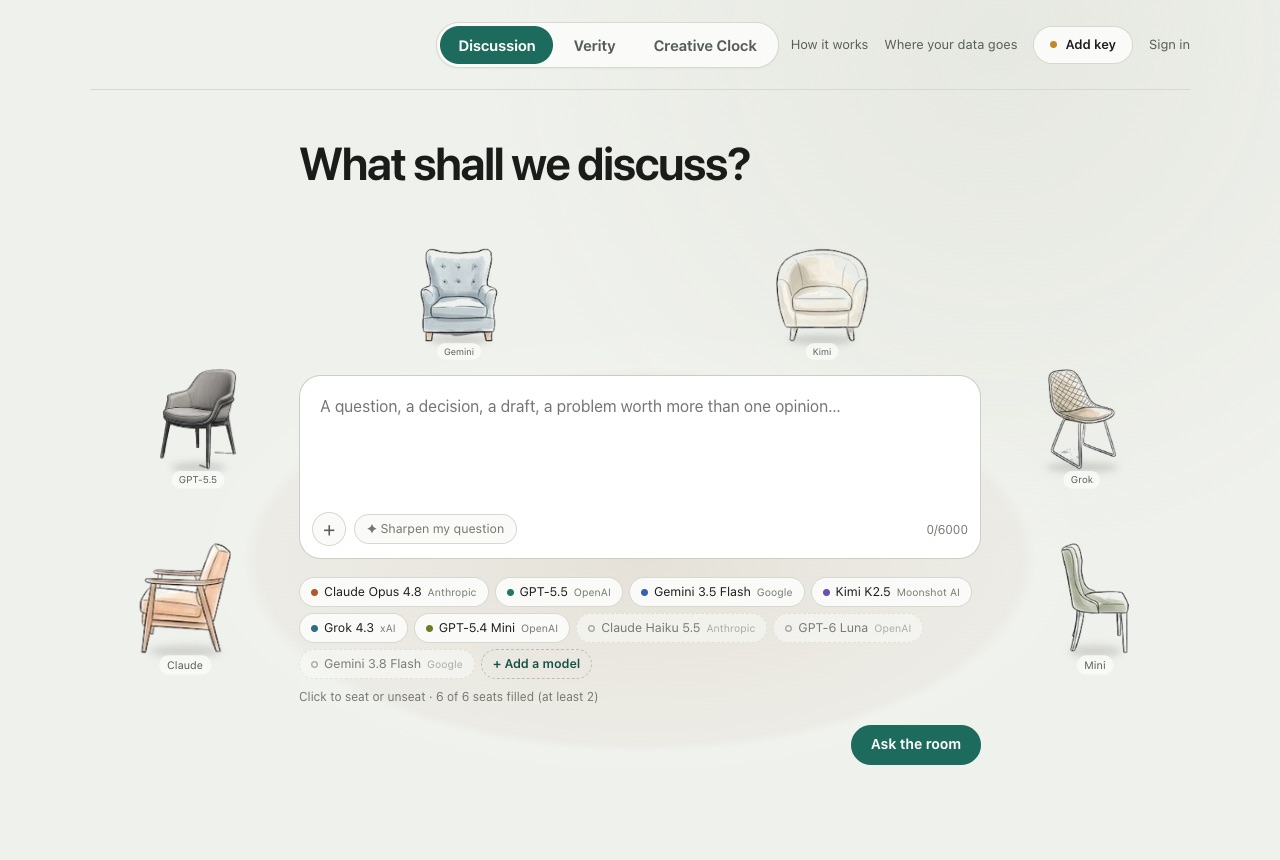
Multi-model reasoning
The Discussion
Five models from different AI companies take one question through three rounds: a blind round where each answers alone, a conversation, then a synthesis. Spoken voices, captions and a PDF record.
theroom.click ↗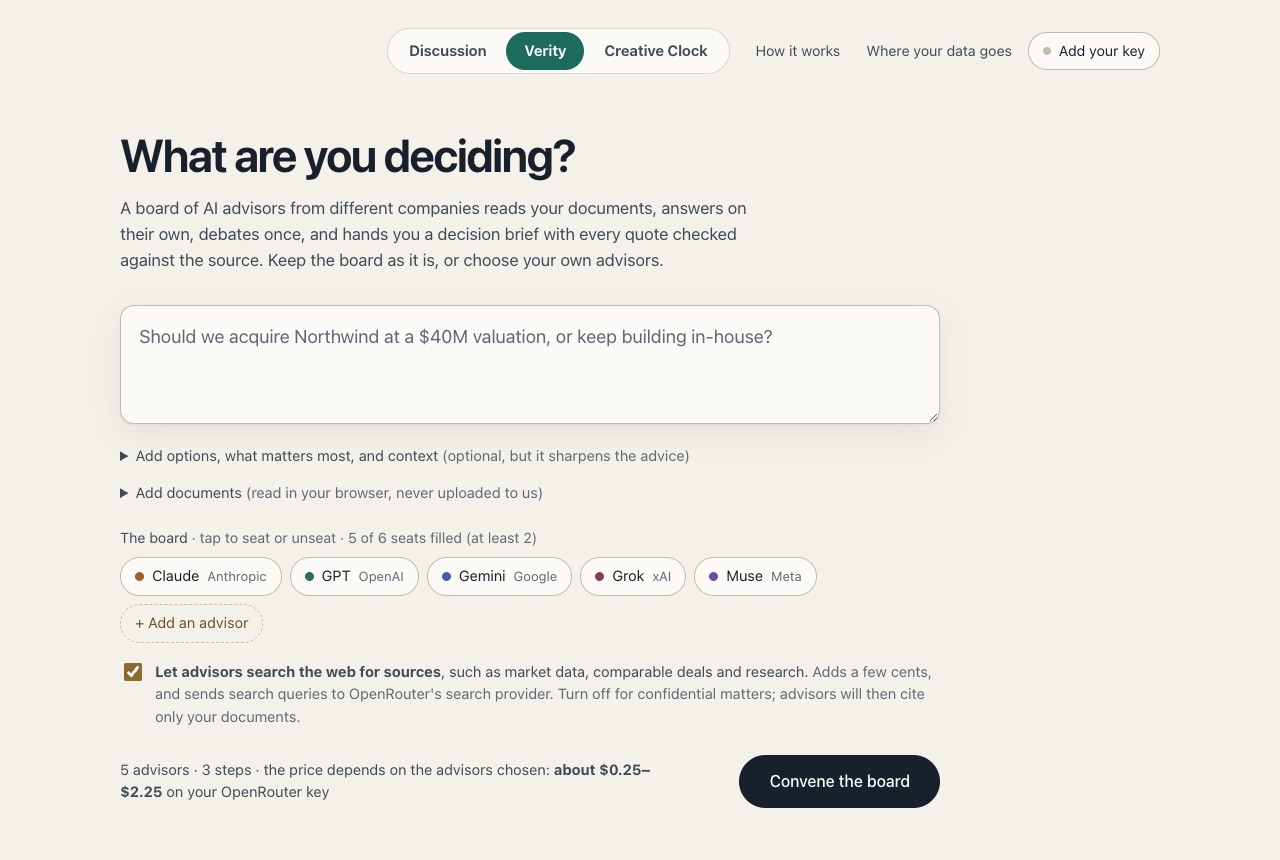
Decisions & documents
Verity
A board of AI advisors for decisions that matter. They read your documents, answer alone, debate once and hand you a decision brief. Every quote they attribute to your documents is checked against the documents themselves.
Try Verity ↗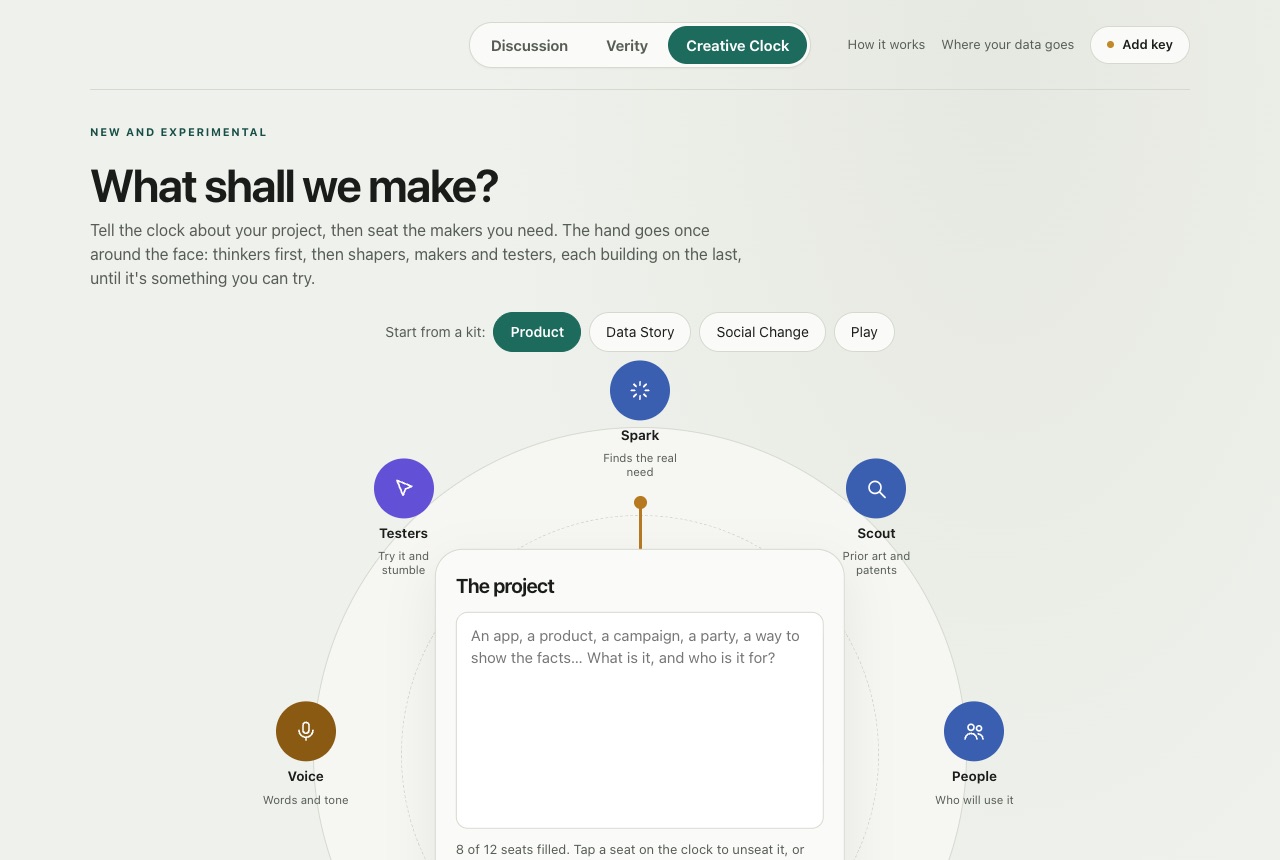
Creative making
Creative Clock
Up to twelve AI “seats” on a clock face, each a different maker: research with citations, images, music, storyboards and a clickable interface prototype. The hand goes around once, and you leave with something you can try.
Open the Clock ↗Industrial reuse · Public data
MatterMatch
One company's waste, byproduct or heat is another's raw material. MatterMatch maps facilities across the U.S., Canada and Mexico from EPA, EIA and national emissions registries, then finds and prices the matches between them.
mattermatch.app ↗ access code on request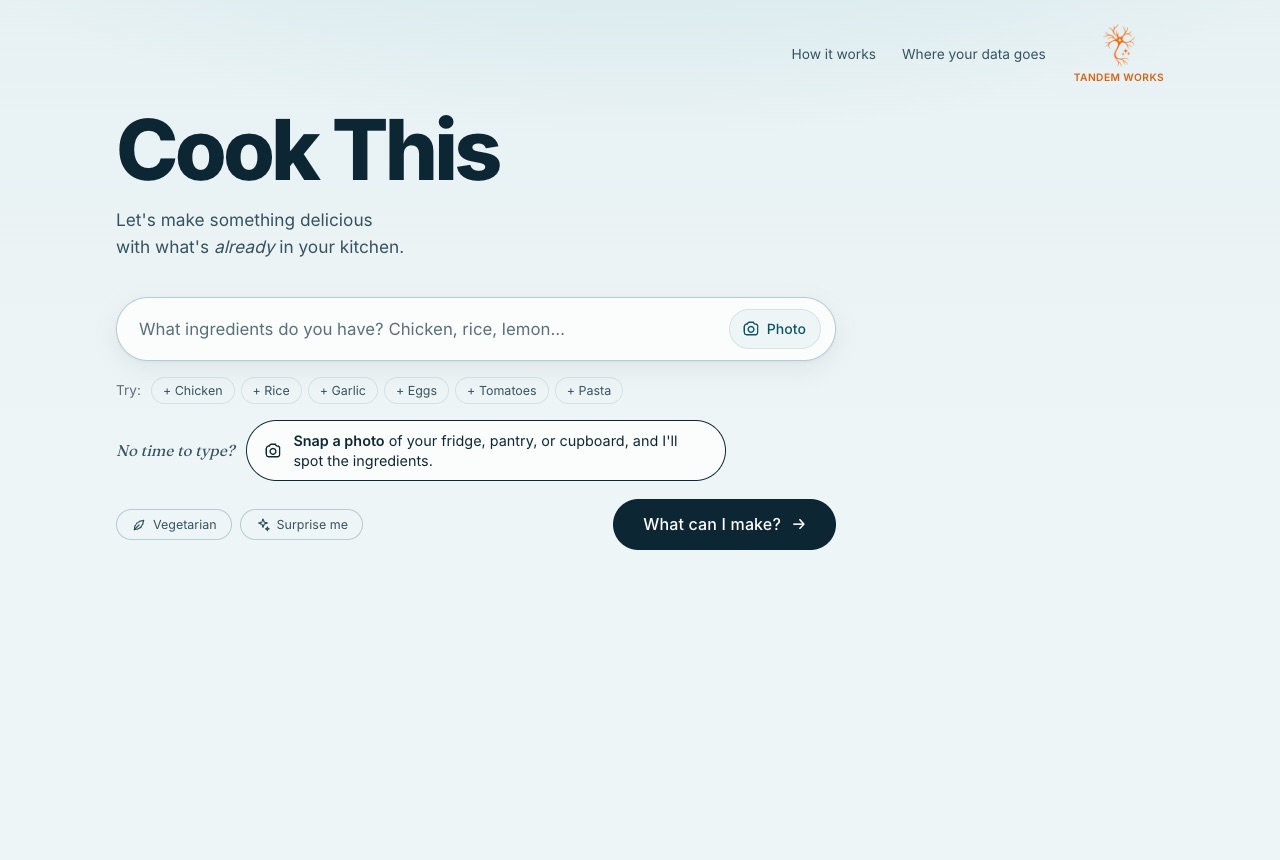
Consumer · White label for grocers and food brands
Cook This
Type what's in your kitchen, or snap a photo of the fridge, and get something delicious to make tonight. It forgives typos, speaks American and British, and is honest about what you actually have. Grocers and food brands can offer it under their own name.
cookthis.link ↗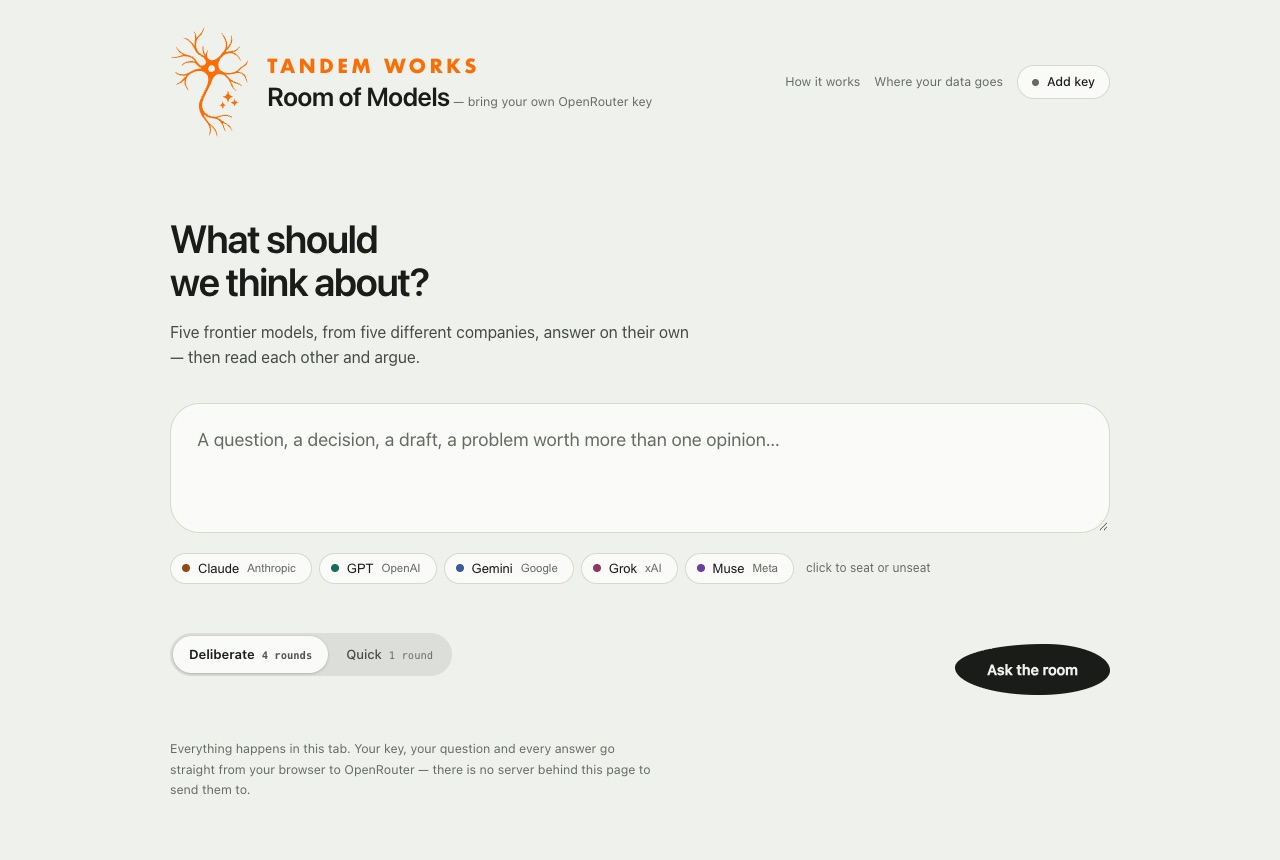
Built live on YouTube with David Langworthy
Room of Models
The original room: five frontier models answer on their own, then read each other and argue. It runs entirely in your browser on your own key, with no server in between.
roomofmodels.site ↗Health · Front door to care
HEALTHWAYS
A resident-facing view of one's own health history, coverage and next steps, drawn as the rings of a tree. Built on standard health-record formats (FHIR) and public Washington data, with synthetic people only.
See a resident's page ↗ access code on request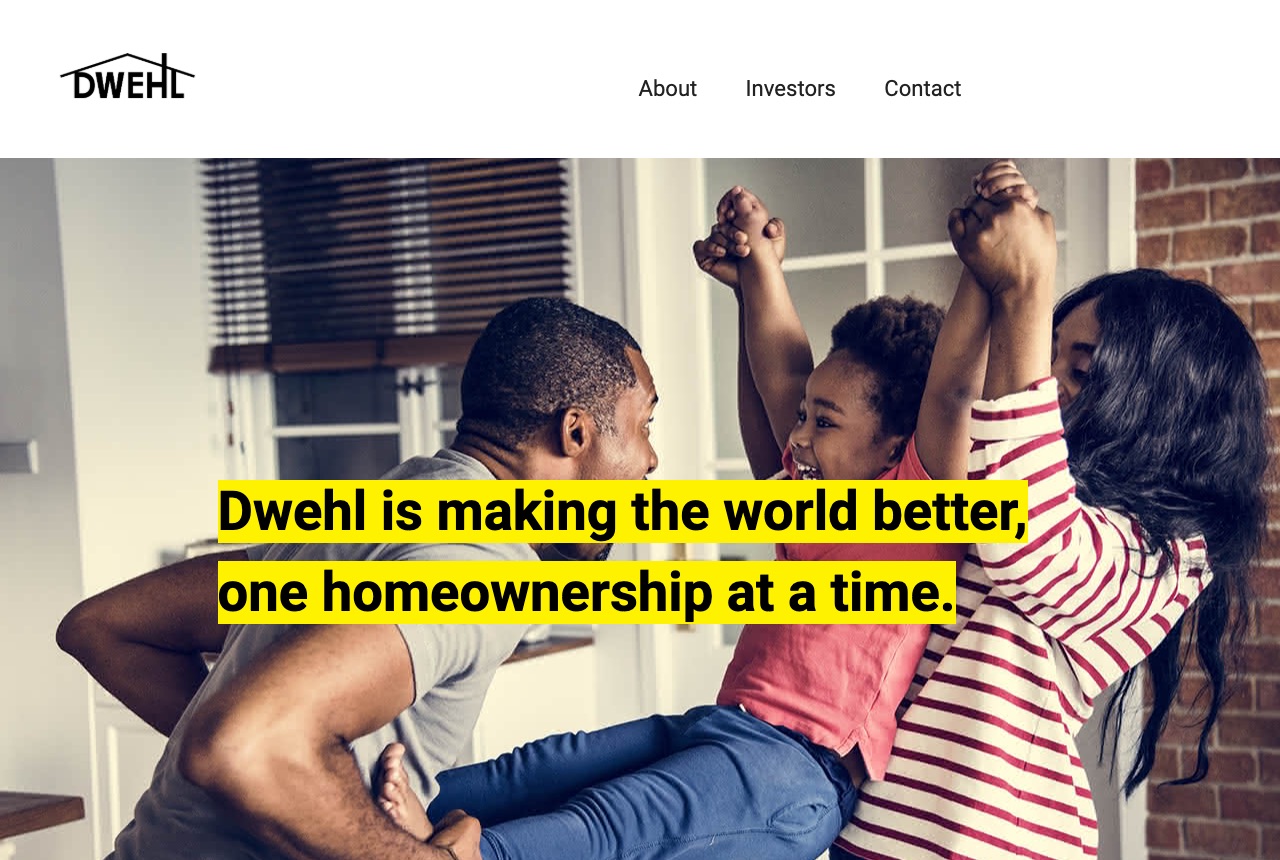
Housing · Rent-to-own
Dwehl
Modern homeownership for working families: a rent-to-own marketplace that connects renters who want to buy with home sellers and investors, so monthly rent builds toward owning a home.
dwehl.link ↗Case study
PATHWAYS: getting people across the gaps.
People most often fall off a path between programs: after high school, after a certificate, after prison. PATHWAYS helps them take the next real step.
What we built
A conversation that becomes a plan. Each turn gathers verified Washington sources, answers, then proposes a route, next steps and wins. Nothing joins a person's plan until they confirm it.
An example route, drawn for this page. Real lives run on several tracks at once: the main route to a license, side jobs that pay the bills, a TikTok channel about the journey, and goals further out. Small leaves are wins; dashed lines are goals still ahead.
How it stays honest
- Real numbers only. Wages, fees, hours and deadlines must come from a verified source and carry a citation and date. If no source has the figure, it says who to ask.
- Quotes checked word for word against the actual source page, and a check after every answer flags any figure with nothing behind it.
- The math is done in code. Income targets and wage gaps are calculated by tested code from official wages and the person's own numbers. The AI explains the result; it never does the arithmetic.
- The AI never writes to the database. Every change it proposes passes a validation layer first.
- Private by design. No real name or email required, access codes stored only as one-way hashes, voice never stored, ID numbers redacted from shared files.
Blind test on realistic Washington questions
Two judges from different AI companies graded each answer against a checklist without knowing which system wrote it.
PATHWAYS is licensed to CampusEvolve, a Seattle startup backed by the Gates Foundation, Schultz Family Foundation and GitLab Foundation, which runs it for Washington. It is shown here with their permission as an example of our work.
How we build
Swiftly, because the testing is built in.
We build with AI coding agents, make other AI models try to break the work, and then watch real people use it.
- Meet the people. Who is it for, and what is the one step they need to finish? We write that down before any code.
- Write the spec. Clear goals and acceptance criteria that a person and a machine can both check.
- Build with agents. Working software in days, with a human making every product call.
- Rival models attack it. Models from other companies critique the design and the code, looking for what we missed.
- Prove it, then ship. Automated tests, blind evaluations against the best general assistants, and extensive real-use testing online and in person: test, improve, test again, until people reach their goal without help.
Never invent a number
Figures come from a named source with a date, and critical math is done in tested code, never by the AI.
The person decides
AI suggests and organizes. People confirm what is saved and what happens next.
Private by default
Collect the least, store less, and route only to AI providers that keep no data.
Calm on a phone
Mobile first, plain words, no gamified noise.
What we can build for you
Bring us a problem people are stuck on.
Guides and navigators
AI that walks people through a complicated system, such as school, work, benefits or health, grounded in your official data.
Decision rooms
Several models read your documents, disagree on the record and hand you a brief you can defend.
Maps from public data
Turn scattered government datasets into something a person can search, see and act on.
Prototypes in days
A working, clickable product to put in front of users, funders or your board, not a mock-up.
The show
TandemWork, live.
Petra Franklin and David Langworthy work live with AI: coding, researching, building and testing, following ideas wherever they lead.
Watch episode 1 ↗About
Petra Franklin, founder
Petra builds the products herself, hands on with coding agents. Before Tandem Works she spent 25 years building companies as co-founder of Vault Capital, backing Glowforge, Terabeam, Clover and HouseValues, and chaired the advisory board of an NSF-funded six-university research center. She has worked with founders, funders, universities and public agencies, and she wants every product to delight the people who use it and solve their challenge.
Let's build the next step.
Tell us who you're building for and where they get stuck. We'll reply within two business days.
petrafranklin@gmail.com